 blog
Best Psychological Thrillers for Tech Professionals
Last Updated: October 28, 2026
Quick Summary
The best psychological thrillers for tech professionals sit where a technical system and a human mind press on each other, drawing dread from both. Eight titles are covered, including The Girl Who Knew My Mind, The Warehouse, Klara and the Sun, The Circle, Recursion, The Gone World, The Fear Index, and Unwind. Four questions help you sort them by where the dread originates and how much technical detail the author commits to.
- A psychological thriller draws tension from a character's interior state; a techno-thriller draws it from technology.
- The Girl Who Knew My Mind follows neuroscientist Kathy Adey through a 2046 London and Glasgow.
- Klara and the Sun is the lightest pick: quiet, sad, and no violence.
- The Gone World and Unwind are the heaviest, with dark premises and disturbing implications.
- Ask whether the technology is a character, a setting, or a plot device before choosing.
Table of Contents
- Why Tech Professionals Gravitate to Psychological Thrillers
- Sci-Fi Psychological Thriller Novels That Get the Tech Right
- Books About Artificial Intelligence and Consciousness
- Books Like Blake Crouch for Readers Who Want Mind Games
- Ethical Technology Thriller Novels for Compliance and Policy Minds
- Psychological Thriller vs Techno-Thriller: What's the Difference?
- Content Notes and Intensity Guidance for Busy Professionals
- Find the Book That Matches Your Professional Curiosity
- Frequently Asked Questions
Why Tech Professionals Gravitate to Psychological Thrillers
The best psychological thrillers for tech professionals speak to a specific exhaustion: you spend your day building systems that watch people and predict their behavior, then want fiction that takes those ideas seriously.
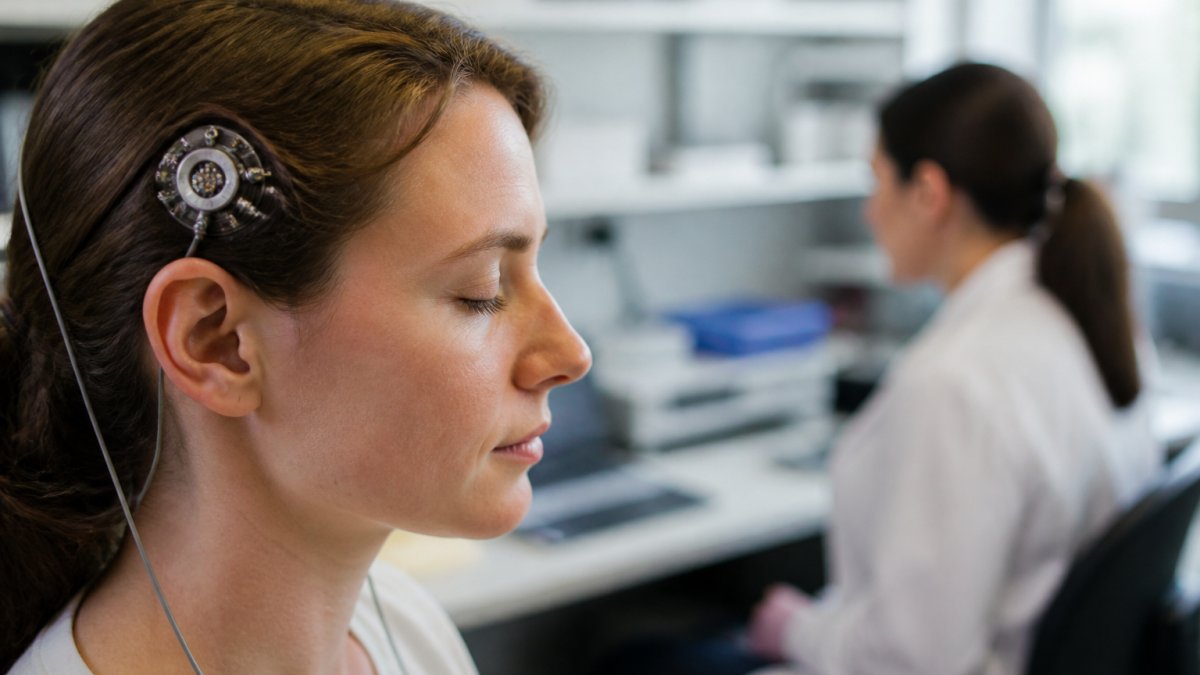
The Girl Who Knew My Mind is a novel about a neuroscientist who finds a mysterious pattern in a world of neural implants, exploring questions of consent, autonomy, and human connection.
Below are eight books for readers interested in technology and psychological thrillers.
Sci-Fi Psychological Thriller Novels That Get the Tech Right
Sci-fi psychological thriller novels don't need to predict the future. They can explore technology and its consequences.
The Girl Who Knew My Mind
The novel follows Kathy Adey, a neuroscientist in a flood-adapted London and Glasgow of 2046, who uncovers a mysterious pattern.
The book explores consent and asks what it means to understand another person.
The novel explores the political implications of speculative technology in an unequal world. To see how we handle those themes, explore the novel's world of neural implants and autonomy.
Best for: readers who want the ethics of consent and control treated as the story, not the decoration. Skip if: you want a fast, plot-only thriller with no interest in the politics.
The Warehouse by Rob Hart
Tech professionals recognize the workplace dynamics immediately: the performance metrics, the internal language, the way a company can be genuinely efficient and genuinely corrosive at once.
Books About Artificial Intelligence and Consciousness
Books about artificial intelligence and consciousness can treat AI as a character or as a mirror. The books below explore these themes.
Klara and the Sun by Kazuo Ishiguro
Plausibility note:
Best for: readers who want the AI-as-mirror angle and don't need a technical blueprint. Skip if: you want a story where the AI's internals are the puzzle.
The Circle by Dave Eggers
Plausibility note:
Best for: readers who want the corporate-power angle and recognize the meeting from the inside. Skip if: you want hard technical speculation about how the systems work.
If neural themes are what pull you in, read more on how neural implants affect personal autonomy.
Books Like Blake Crouch for Readers Who Want Mind Games
Readers searching for books like Blake Crouch may be interested in these two books.
Recursion by Blake Crouch
The technical details are loose, but the psychological logic holds. That's the trade most readers will accept.
The Gone World by Tom Sweterlitsch
If you finish the Crouch section and want a curated next step, find mind-bending sci-fi books about memory and consciousness.
Ethical Technology Thriller Novels for Compliance and Policy Minds
Ethical technology thriller novels explore questions about technology and its consequences.
The Fear Index by Robert Harris
Compliance readers will recognize the pattern: governance failure dressed as a market story.
Unwind by Neal Shusterman
If you want a deeper look at how speculative fiction connects to real policy debates, there's a guide on how speculative fiction informs technology policy.
Psychological Thriller vs Techno-Thriller: What's the Difference?
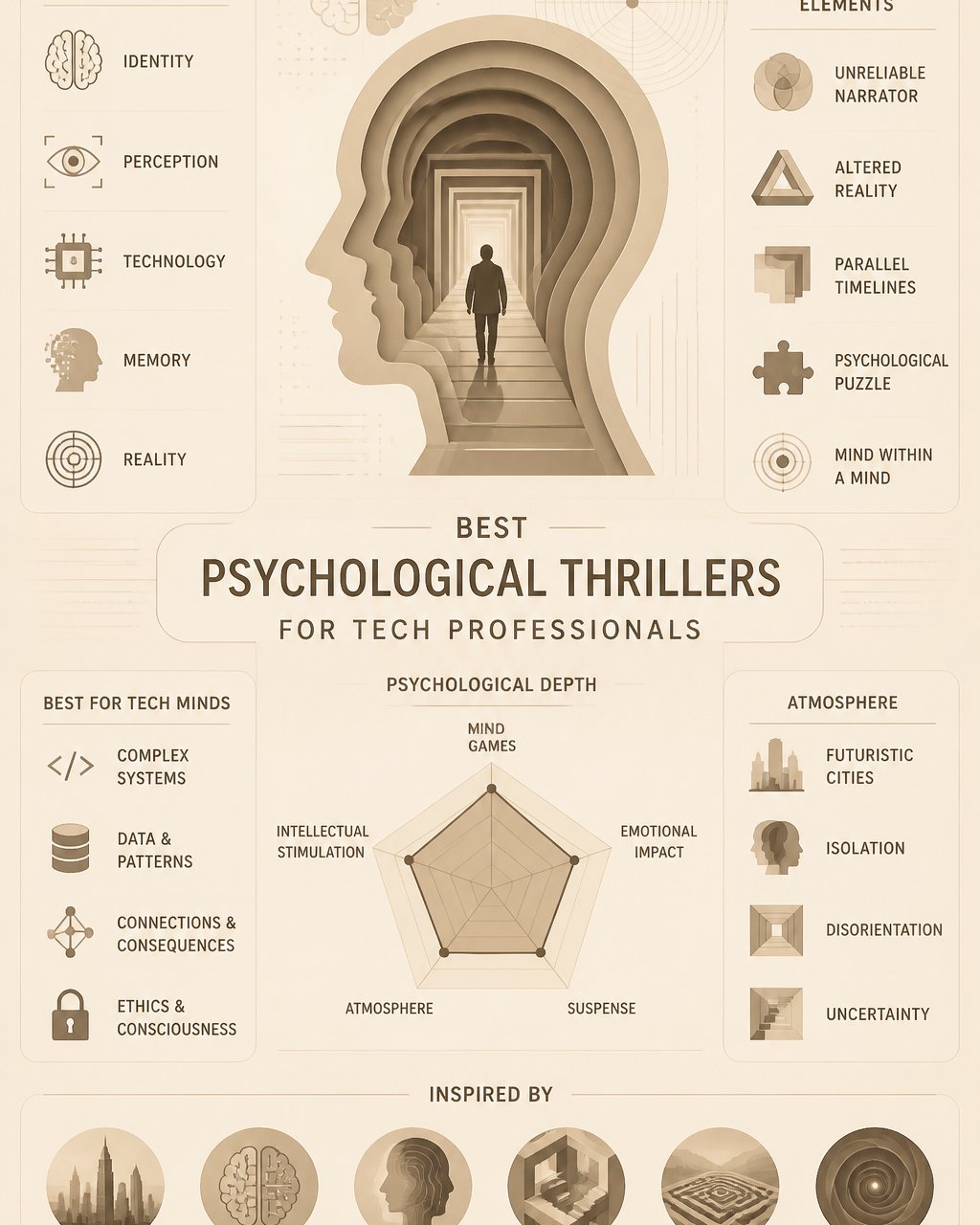
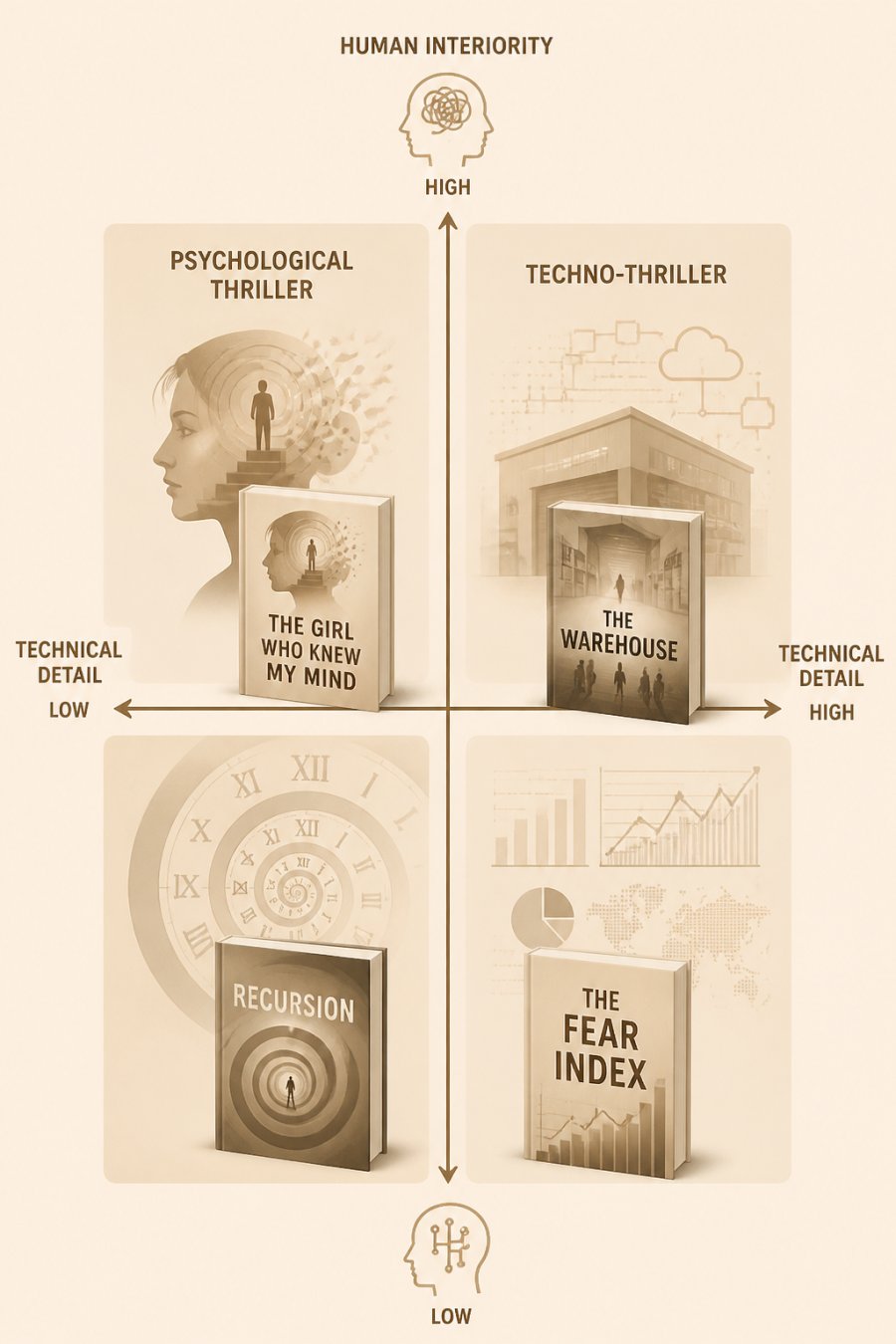
A psychological thriller draws its primary tension from a character's interior state: perception, memory, sanity, or identity. A techno-thriller draws it from technology and its consequences. Psychological thrillers for tech professionals can sit in the overlap, where a technical system and a human mind press on each other.
The distinction can help when choosing what to read: dread from inside a character's head is psychological, dread from a system is techno, and books where technology is why the character can't trust their own perception give you both.
Here's a framework for considering titles if you work in tech.
Four questions to ask before you pick
1. Where does the dread originate? If the answer is "a character's unreliable memory," you're in psychological territory. If it's "a system behaving outside its spec," you're in techno territory. If it's "a character can't tell whether the system or their own mind is the problem," you've found the overlap, and that's usually the most rewarding read for someone who builds systems for a living.
2. How much technical detail does the author commit to? Techno-thrillers vary wildly here. Some name real protocols and real failure modes; others wave at "the algorithm" and move on. Neither approach is wrong, but they serve different readers. If you want to audit the author's homework, look for books that specify mechanisms. If you want momentum, look for books that don't.
3. Is the technology a character, a setting, or a plot device? A character (Klara) invites you to think about minds. A setting (The Circle's campus) invites you to think about culture. A plot device (a memory machine in Recursion) invites you to think about consequences. Knowing which one you're in tells you what kind of evening you're signing up for.
4. Does the book respect its own rules? A thriller can invent any technology it wants, but once it sets limits, it has to live inside them. Books that cheat, where the system does whatever the plot needs, may frustrate some readers.
A quick way to sort the eight titles on this list
| Title | Dread originates in | Tech detail | Technology is a... |
|---|---|---|---|
| The Girl Who Knew My Mind | Mind and system together | Committed | Character and setting |
| The Warehouse | The organization | Light | Setting |
| Klara and the Sun | The humans | Light | Character |
| The Circle | The culture | Light | Setting |
| Recursion | The premise | Loose | Plot device |
| The Gone World | The premise and the world | Moderate | Plot device |
| The Fear Index | The system | Moderate | Character |
| Unwind | The policy | Light | Setting |
For readers who want more thrillers that play with perception and reality, there's a list of seven that challenge how you see things.
Content Notes and Intensity Guidance for Busy Professionals
Here's a short guide to the books' themes.
- Lightest: Klara and the Sun. Quiet, sad, no violence.
- Moderate: The Circle, The Warehouse. Corporate dread, some bleak turns.
- Heavier: Recursion, The Girl Who Knew My Mind. Identity pressure, ethical unease.
- Heaviest: The Gone World, Unwind. Dark premises, disturbing implications.
| Book | Subtype | Intensity | Best For |
|---|---|---|---|
| The Girl Who Knew My Mind | Sci-fi psychological thriller | Moderate-heavy | Ethics and consent themes |
| The Warehouse | Corporate dystopia | Moderate | Workplace recognition |
| Klara and the Sun | AI and consciousness | Light | Quiet unease |
| The Circle | Corporate power | Moderate | Transparency debates |
| Recursion | Mind games | Heavy | Fast, twisty plotting |
| The Gone World | Dark sci-fi thriller | Heaviest | Bleak, strange premises |
| The Fear Index | Ethical tech thriller | Moderate | Governance failure |
| Unwind | Policy-driven dystopia | Heaviest | Policy logic |
Find the Book That Matches Your Professional Curiosity
Psychological thrillers can explore questions about technology and human experience.
The Girl Who Knew My Mind follows Kathy Adey through a future London and Glasgow, exploring neural technology, consent, autonomy, and what it means to understand another person.
Find The Girl Who Knew My Mind.
Frequently Asked Questions
What is the difference between a tech thriller and a psychological thriller?
A tech thriller builds suspense from systems: hacking, surveillance, AI, or corporate control of data. A psychological thriller builds suspense from a character's interior world: memory, perception, obsession, and doubt. Psychological thrillers for tech professionals can sit in the overlap, where a technical system and a human mind are both unreliable. The Girl Who Knew My Mind explores neural technology and follows Kathy Adey as she uncovers a mysterious pattern that challenges her perception of reality.
Which psychological thrillers would appeal to software engineers?
The Girl Who Knew My Mind follows neuroscientist Kathy Adey as she uncovers a mysterious pattern that challenges her perception of reality and explores neural technology and personal autonomy.
Are there psychological thrillers about neural technology or brain-computer interfaces?
The Girl Who Knew My Mind is set in a flood-adapted London and Glasgow of 2046 and explores neural technology, consent, consciousness, and personal autonomy. It invites readers to consider what it means to understand another person.
What books are similar to Blake Crouch's psychological thrillers?
The Girl Who Knew My Mind explores neural technology, consciousness, and personal autonomy through neuroscientist Kathy Adey's discovery of a mysterious pattern.