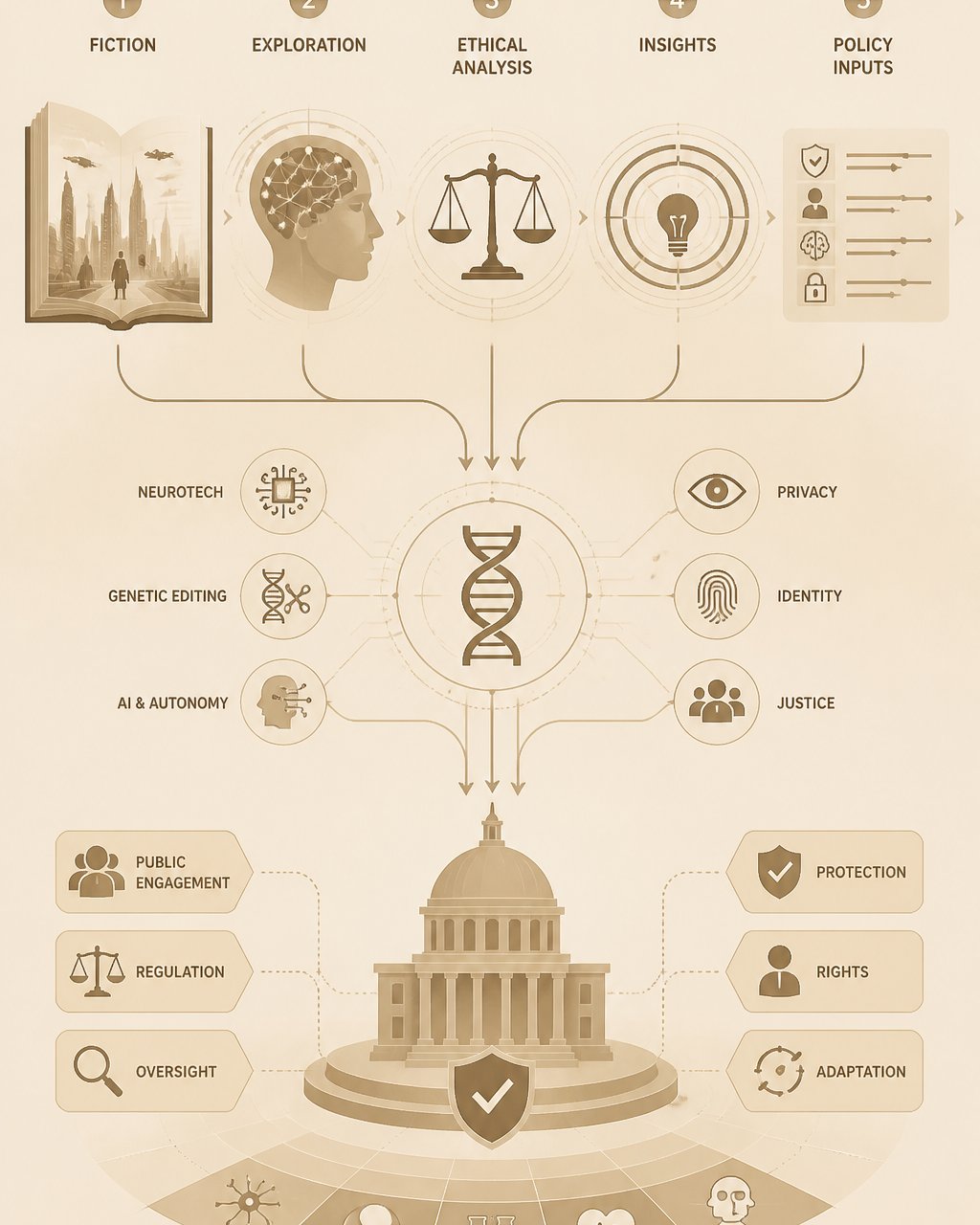
 how-to
How to Use Fiction to Shape Bioethics Policy
Last Updated: October 30, 2026
Quick Summary
Fiction influences bioethics policy by giving abstract dilemmas a human face, helping committees frame better questions even though stories are not evidence. Use fiction as a tool for framing, not proof: select a scenario matching a live policy question, map stakeholders, then test it against real evidence.
- Start with the policy question, not the book; the match matters more than prose quality.
- Map every stakeholder and tension, since stories surface people a technical brief forgets.
- Run the five-question test covering plausibility, representativeness, bias, risk distortion, and assumptions.
- When narrative and data disagree, the data wins; label thought experiments as such.
- Name the work, the scene, and the real debate it maps onto in any memo.
Table of Contents
- Why Stories Change How We Think About Bioethics Policy
- A Step-by-Step Method for Turning Fiction Into Policy Discussion
- Fictional Case Studies in Bioethics That Changed the Conversation
- Science Fiction and Technology Policy: From Cautionary Tales to Committee Rooms
- Ethical Issues in Neural Technology: What Speculative Stories Reveal
- Narrative Ethics in Healthcare: Empathy, Illness, and Medical Decision-Making
- The Limits of Fiction: Where Stories Fall Short of Evidence
- Bringing Speculative Fiction Into Your Next Policy Review
- Frequently Asked Questions
Why Stories Change How We Think About Bioethics Policy
A dry policy memo rarely changes a mind. A story about one patient, one implant, one family deciding whether to consent, does something a memo cannot: it makes the ethical dilemma feel real.
This guide looks at that process honestly. Stories are not evidence, so the trick is using them well.
The short version: fiction is a tool for framing, not proof. It helps you ask better questions; it does not answer them.
A Step-by-Step Method for Turning Fiction Into Policy Discussion
Most guides treat fiction as inspiration and stop there. A story only earns its place in a policy review when you can trace it back to a live question, a set of stakeholders, and the evidence beside it.
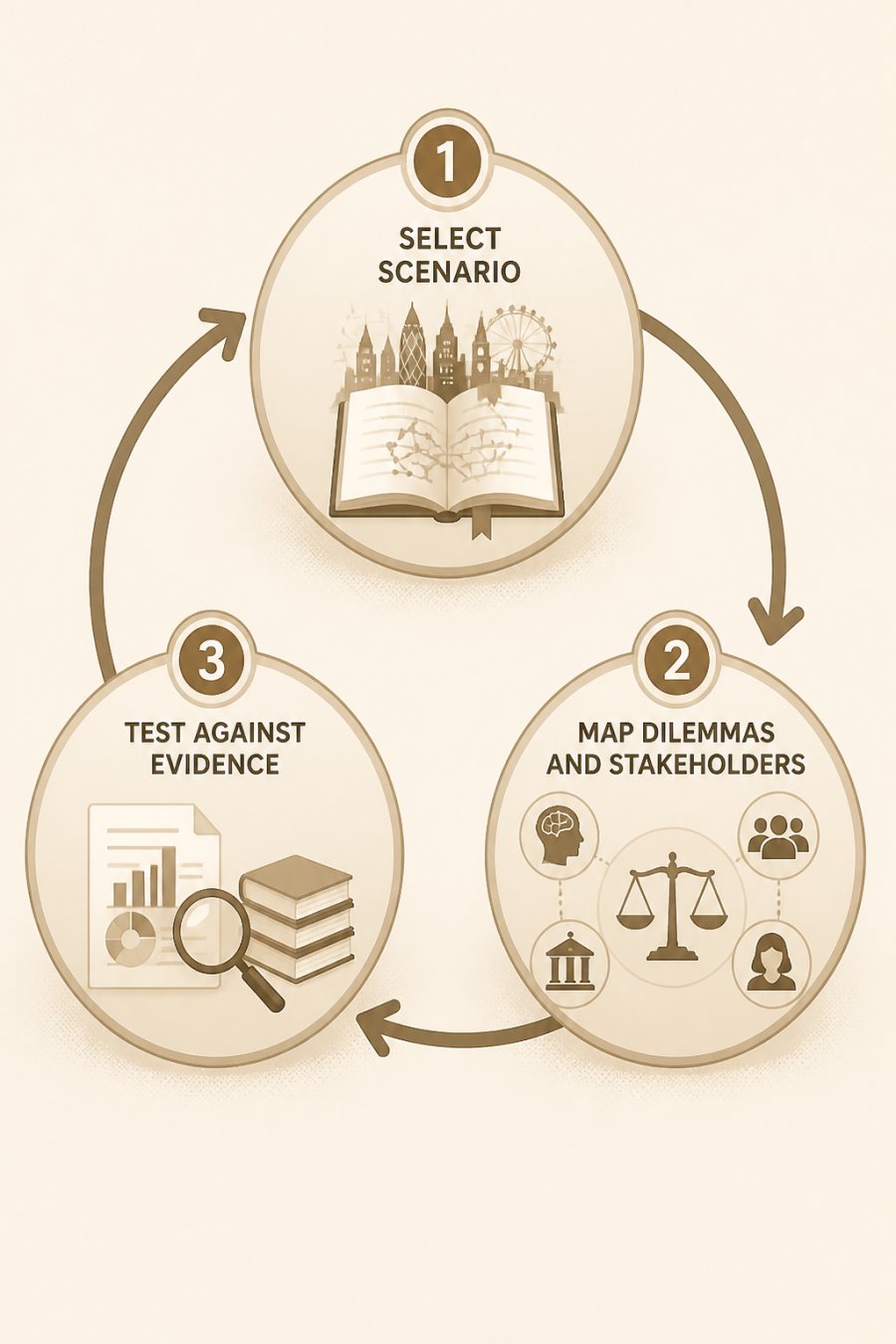
Step 1: Select a Scenario That Matches a Live Policy Question
Start with the policy, not the book. Write down the exact question your committee is weighing. Something like "when should neural data count as personal health data?" Then find a fictional scenario that stages that question. A novel set in a future London where implants blur the line between memory and surveillance can do this well.
The match matters more than the prose quality. A brilliant story about the wrong question wastes everyone's time.
Step 2: Map the Ethical Dilemmas and Stakeholders
Pull the story apart. List every party with something at stake: the patient, the clinician, the company, the regulator, the family. Then name the tensions between them.
- Who holds power and who does not?
- Where does consent break down?
- Whose voice is missing from the room?
This mapping is where fiction earns its keep: stories surface stakeholders a technical brief forgets, especially the people living with the consequences.
Step 3: Test the Scenario Against Real Evidence
Here is the step almost everyone skips. A fictional scenario is a hypothesis, not a finding.
Watch out: the biggest mistake is letting a compelling narrative stand in for data. A story can make a risk feel urgent. It cannot tell you how often that risk occurs.
The method runs in three steps, each with a distinct job.
| Step | What to do | Key point |
|---|---|---|
| Step 1 | Select a scenario that matches a live policy question | Match matters more than prose quality |
| Step 2 | Map the ethical dilemmas and stakeholders | Stories surface stakeholders a technical brief forgets |
| Step 3 | Test the scenario against real evidence | A fictional scenario is a hypothesis, not a finding |
Fictional Case Studies in Bioethics That Changed the Conversation
Fiction has repeatedly moved the bioethics conversation forward, even when it could not settle it. The pattern is consistent: a story names a fear or hope before institutions do, and the public starts using its language. What separates a story that shifts a debate from one that merely entertains is specificity, a recognizable technology, institution, and person caught between them.
Here are documented cases where a fictional work became a reference point in real bioethics discussion, across different policy domains.
Genetics and reproductive selection
Aldous Huxley's Brave New World (1932) is the most-cited fictional touchstone in debates about reproductive technology and genetic selection, routinely invoked in bioethics teaching and public argument as shorthand for a society that engineers its children. It produced no law, but it gave critics a shared vocabulary, "designer babies," "hatcheries," "conditioning", that still shows up in ethics syllabi and public comment periods.
Organ allocation and end-of-life care
Kazuo Ishiguro's Never Let Me Go (2005) stages a society that raises clones to donate organs, and it has become a standard reference in discussions of organ procurement, donor consent, and exploitation. Its power is that it normalizes the horror, the characters accept their fate, forcing readers to ask how institutions make unacceptable arrangements feel ordinary, a question that maps onto real debates about presumed consent and the treatment of living donors.
AI in medicine and machine consciousness
Science fiction has shaped how the public imagines medical AI and machine moral status. Works portraying artificial minds as patients or clinicians give ethicists concrete scenarios, who is liable when an AI clinician errs, whether a sufficiently complex system can hold interests, how consent works when the decision-maker is not human. These are live questions in clinical AI governance, and fictional scenarios give committees a shared image to reason from before the technology arrives.
Neural technology and autonomy
Speculative fiction about brain-computer interfaces has become a reference frame for debates about neural data, cognitive liberty, and consent. Stories showing a device eroding autonomy one small permission at a time give regulators language for gradual harms that privacy frameworks built for discrete data breaches struggle to capture.
What the cases have in common
Three patterns recur across these examples:
- The story arrives before the institution. Fiction names the problem while the technology is still speculative, giving policymakers a head start on framing.
- The vocabulary travels. Terms coined or popularized by fiction show up in hearings, op-eds, and ethics curricula, where they do real argumentative work.
- The story rarely produces a law by itself. It changes the terms of debate, not the statute. Advocates still have to do the evidentiary work.
The lesson for policy work: treat these stories as conversation starters, then hand the conversation to the evidence. A named work beats a vague gesture, because you can point to the exact scene, assumption, and real-world debate it maps onto.
Science Fiction and Technology Policy: From Cautionary Tales to Committee Rooms
Cautionary tales have a long reach into technology policy. Writers imagine a plausible future, readers recognize a real trend inside it, and pressure builds to act before the trend hardens into infrastructure.
But a cautionary tale is a warning, not a forecast. The strongest policy work uses science fiction to widen the range of futures under discussion, then narrows back to what can be tested.
Ethical Issues in Neural Technology: What Speculative Stories Reveal
Neural technology raises questions ordinary privacy frameworks struggle to hold. When a device sits inside a person's mind, consent, identity, and control start to blur.
The recurring themes are worth naming:
- Consent that is technically given but not truly informed
- Data that captures thought, not just behavior
- Autonomy that erodes one small permission at a time
These are exactly the issues ethics and compliance teams wrestle with. Stories do not resolve them, but they give a team shared language for the argument. Readers exploring these questions can go deeper with this article on how neural implants affect personal autonomy.
Narrative Ethics in Healthcare: Empathy, Illness, and Medical Decision-Making
Narrative ethics holds that stories carry moral weight. A patient's account of illness, a clinician's memory of a hard decision, a family's recollection of a death: these are not decoration around the ethics.
In healthcare, this matters for medical decision-making. A guideline can tell you what is generally right. A narrative shows you what a specific person faced, and why the general rule felt wrong in that room.
Scholars in bioethics education have long argued that narrative engagement builds empathy and moral imagination in ways case summaries do not. For essays on consciousness, psychology, and the ethics of sharing private experience, explore the TGWKMM blog.
The Limits of Fiction: Where Stories Fall Short of Evidence
Fiction has real limits, and policy analysts should name them out loud. A story is engineered for emotional resonance, that is its power and its danger. Naming the danger is not enough; you need a way to test a scenario before you let it into a policy discussion. Most guides stop at "be careful." Here is a framework you can actually run.
A five-question test for any fictional scenario
Before a story earns a place in a policy review, put it through these five questions and write down the answers.
- Plausibility. Does the technology or institution in the story work the way real systems work, or does it assume a capability that does not exist? If the story assumes a device can read thoughts cleanly, check whether any real system can. If not, the scenario is a thought experiment, not a forecast, label it as such.
- Representativeness. Whose experience does the story center, and whose does it leave out? A story about one sympathetic patient can stack the deck toward one conclusion. Ask who is missing: the uninsured, the non-English speaker, the person who cannot consent, the community that bears the risk without the benefit.
- Bias and stereotype. Does the story rely on a stock character, the mad scientist, the greedy corporation, the passive patient, that flattens the real actors? Stereotypes are efficient narrative devices and poor policy guides.
- Risk distortion. Does the story make a rare harm feel common, or a common harm feel exotic? Vividness is not frequency. A dramatic scenario can inflate perceived risk and crowd out the quieter, messier data.
- Assumption audit. List every factual claim the story depends on and mark each as verified, plausible, or invented. This is the step that keeps a compelling narrative from standing in for evidence.
How to use the test in practice
Run the five questions on a single page. If a scenario fails plausibility or representativeness, you can still use it, but only as a framing device, clearly labeled, never as evidence. If it passes, cite it alongside real research and law. The record of where the story helped and where it misled is the difference between using fiction and being used by it.
The failure modes to watch for
- Sensationalism. A scenario engineered for shock can dominate a discussion it should only inform.
- Single-story reasoning. One narrative can crowd out the base rates and the disaggregated data.
- Emotional manipulation. A story can make a conclusion feel obvious before the evidence is in.
The fix is not to avoid fiction. Pair every story with a check against evidence and a clear note on what it assumes. When narrative and data disagree, the data wins. When the data is silent, the story can still help you frame the question, as long as you say so and show your work.
Bringing Speculative Fiction Into Your Next Policy Review
You can run this in your next review without much setup. Pick one live question. Choose a story that stages it. Map the stakeholders, then test the scenario against what you actually know. Write down where the story helped and where it misled.
A well-chosen novel does something a briefing cannot: it lets a committee feel a dilemma before it has to rule on it.
Frequently Asked Questions
How can fiction influence bioethics policy?
Fiction influences bioethics policy by making abstract ethical dilemmas concrete and emotionally legible. A novel or short story can place readers inside a decision, showing how a neural implant, a consent form, or a diagnosis feels from the inside. That emotional engagement gives policymakers and ethics committees shared language for discussing values. The influence is indirect: stories do not set policy, but they shape the questions people ask, the stakeholders they notice, and the scenarios they rehearse before drafting guidance.
Can science fiction help policymakers anticipate ethical problems in neural technology?
Science fiction and technology policy work well together because speculative stories extrapolate current trends into plausible futures. A story about neural implants that blur the line between memory and data can surface ethical issues in neural technology before products reach the market. Policymakers can use these scenarios as thought experiments, asking which harms are plausible, who is affected, and what safeguards would be needed. The key is to treat fiction as a prompt for structured deliberation, not as evidence of what will happen.
What are the limitations of using fiction to guide bioethics policy?
Fiction can distort as much as it illuminates. Stories compress timelines, dramatize conflict, and often simplify technology in ways that mislead. A compelling narrative may overstate risk or ignore regulatory context. Fiction also reflects the author's values and cultural assumptions, not a representative sample of public opinion. For bioethics policy, stories should be paired with empirical research, stakeholder consultation, and legal analysis. Use fiction to open questions, not to close them.
How can a novel be analyzed as a bioethics case study?
Treat the novel's central dilemma as you would a clinical or research ethics case. Identify the decision, the parties affected, the values in tension, and the information each party holds. Ask where consent is given or withheld, who bears risk, and what alternatives existed. Then compare the fictional scenario with real guidance and evidence. This method turns narrative ethics in healthcare into a practical exercise: the story supplies the emotional and human texture, while the case analysis supplies rigor.
The hard part is not finding a story. It is keeping the story honest when it starts to feel like proof. The Girl Who Knew My Mind was written for exactly that tension, exploring neural implants, consciousness, and the struggle for autonomy in an unequal world. If you want a narrative that gives your team shared language for the consent and control questions you are already facing, find the book and put it to work in your next review.